Ready for an adventure? Call +44 (0)2381 449447 or email info@different-travel.com Your Account

Follow us

Trek Kilimanjaro: Roof of Africa 2027

9th Oct 2027 - 19th Oct 2027

11 days/Tanzania /Challenging to Extreme

Overview

Trip Summary | The Poppleton Centre Trek Kilimanjaro 2027

Enjoy one of the world’s most iconic treks and hike to the summit of the highest mountain on the African continent, Mount Kilimanjaro.

This beautiful trek will take you through five distinct ecological zones, making each day a new visual feast; from the lush rainforest, to strange semi-desert landscapes and right up into the Arctic zone where you will see enormous blue-tinged glaciers and the famous Kilimanjaro summit sign!

We will take the stunning Machame Route to the top, which is considered one of the most stunning on the mountain but also one of the best for acclimatisation. This incredible journey will take you up to altitudes of 5895m, and while it is achievable by anyone with a good level of fitness, the Kilimanjaro challenge is not to be underestimated!

At 7 days, this trek is one day longer than most, which offers you the greatest chance of reaching the summit because of the all-important acclimatisation opportunities.

Our dedication to porter welfare with KPAP
Anyone who has trekked Kilimanjaro will tell you that the hard-working porters are vital to your success in reaching the summit.

The Different Travel Company are proud to be one of a small number of UK tour operators who are official partners of the International Mountain Explorers Connection (IMEC), which works closely with the Kilimanjaro Porters Assistance Project (KPAP) to improve conditions for porters and mountain crew on Kilimanjaro.

Being a partner of IMEC means that when you trek Kilimanjaro with Different Travel, you can rest assured that the staff will be provided with good meals throughout the trek, are paid well, sleep in high-quality tents and have mountain-appropriate clothing and footwear to ensure their safety on the mountain – just as we would expect for our participants.

You are encouraged to learn about the importance of porter protection at http://www.kiliporters.org.

Fitness Requirements

A challenging to extreme trip. You will be trekking on challenging terrain which is often steep; you will be exposed to altitudes up to 5895m and will camp in basic campsites. Each day you will trek for up to 8 hours.

Summit night is the most challenging part of the trek because it starts at 11pm or 12am after only a few hours of sleep. You trek through the cold and dark of the night up to the summit on a loose scree path until you reach the top of the crater at Stella Point, around 6-7 hours later. You then take around an hour to trek around the crater rim to the true summit, Uhuru Peak. It is an incredibly arduous night. You need to stay positive, remember your goal, and keep a very slow, steady pace. The hard work pays off when you reach the summit and take your photos at the famous signpost! You then take an almost immediate descent of 5-6 hours to a much lower altitude campsite, where you will have a well-deserved rest. It could be a 14-hour trek day.

Participants should arrive in Tanzania with a good level of fitness, having completed appropriate training before departure. A positive mindset, good overall health and a willingness to step outside your comfort zone will all help you get the most from this incredible challenge.

The minimum age for this challenge is 18, or 16 to 17 when accompanied by an adult. There is no upper age limit, and participants of all ages have successfully reached the summit with the right preparation and determination.

Throughout your trek, you’ll be accompanied by experienced, English-speaking local guides who have summited Kilimanjaro hundreds of times across its various routes, alongside a Different Travel Company UK Tour Manager. All are first aid trained and will provide expert support and encouragement every step of the way.

Behind the scenes, a dedicated team of assistant guides, cooks and porters work tirelessly to make your adventure possible. Their knowledge, hard work and warm hospitality play a vital role in ensuring a safe, enjoyable and unforgettable experience on the mountain.

The terrain changes throughout the trek as you pass through a variety of landscapes and climate zones. As you gain altitude, the route gradually climbs towards the summit before descending on the return journey. Underfoot, you’ll encounter everything from muddy forest paths and rocky trails to barren volcanic terrain, loose scree and, depending on conditions, even snow.

Around the halfway point, you’ll tackle the famous Barranco Wall. Although it appears imposing, no technical climbing skills are required. Instead, you’ll scramble over large rocks along a narrow, winding path with some exposed sections. Your guides and support team will be on hand to assist throughout, and many trekkers describe this as one of the highlights of the entire adventure.

For most of the trek, you’ll follow the principle of “trek high, sleep low.” This means you’ll climb to higher elevations during the day before descending to a lower altitude to sleep, giving your body valuable time to rest, recover and acclimatise. During the first four nights, you’ll camp at altitudes no higher than 3,963m, helping your body gradually adjust to the thinner air.

Even with this carefully planned itinerary, the effects of high altitude should not be underestimated. Everyone responds differently to altitude, regardless of age or fitness, so it’s important to listen to your guides, stay well hydrated and let your body adapt at its own pace.

You’ll stay in a comfortable hotel in Moshi before and after your trek, with the remaining nights spent camping on the mountain.

Accommodation is on a shared basis throughout the trip, although single rooms may be available at the hotels for an additional supplement, subject to availability.

On the mountain, you’ll sleep in spacious three-person tents shared between two participants. A sleeping mattress is provided, but you’ll need to bring your own sleeping bag or hire one locally if preferred. If you’d like a little extra comfort, you may also wish to bring an additional inflatable or foam sleeping mat.

All meals on the mountain are freshly prepared by your dedicated trek cooks, who serve a variety of hearty, nutritious Tanzanian and Western dishes to help keep you fuelled throughout the challenge.

Meals are enjoyed together in a communal mess tent, where tables, chairs, plates, mugs, cutlery and all other dining equipment are provided, giving you a comfortable space to relax, eat and socialise after each day’s trekking.

Preparing properly for Kilimanjaro is one of the most important factors in giving yourself the best chance of reaching the summit and enjoying the experience. A good level of fitness will not only make each day’s trekking more manageable but will also help you recover more effectively between days.

Although no technical climbing skills are required, Kilimanjaro is a high-altitude mountain and should never be underestimated. Arriving well prepared will increase your chances of success, help you cope better with the demands of the trek and ensure you can fully enjoy this incredible adventure alongside your teammates.

Itinerary

Trek Kilimanjaro: Roof of Africa 2027

Day 1 (Saturday 9 October 2027):

UK – Kilimanjaro
Depart for Kilimanjaro International Airport on an indirect flight. (Overnight: Flight)

Day 2 (Sunday 10 October 2027):

Moshi
On arrival, you will be met by your local guide and transferred to your hotel in Moshi, where you have free time to freshen up before a briefing and welcome dinner tonight.
Meals: Dinner
Overnight: Hotel in Moshi

Day 3 (Monday 11 October 2027):

Machame Gate – Machame Huts (3,000m)
After a hearty breakfast, we set off for the 45-minute drive to Machame Gate, where we will be officially registered for the trek and meet our assistant guides, cooks and porters. After registration is complete and your porters have been allocated their loads, you will start the trek at a slow and gentle pace on a gentle uphill incline trail through the beautiful rainforest. Keep your eyes peeled for monkeys who make this area their home, and see if you can spot the beautiful seahorse-shaped red flower, Impatiens kilimanjari, which only grows on the mountain. The trek day typically takes 7–8 hours, ending at a clearing in the forest and the welcome sight of your tents, hot tea and dinner.
Meals: Breakfast, lunch, dinner
Overnight: Campsite

Day 4 (Tuesday 12 October 2027):

Machame Huts – Shira Plateau (3,840m)
After a hot breakfast, you will start the trek through the remaining rainforest towards the giant moorland zone. The trek today is shorter but steeper, and the environment changes rapidly as you leave the rainforest. Depending on the group’s pace, it is a 5-6 hour trek, during which you gain approximately 800 metres in altitude. You will arrive at Shira Camp at around lunchtime and enjoy the stunning view over the Shira Plateau. Weather permitting, you should also get your first close views of Kibo, the iconic peak of Kilimanjaro.
Meals: Breakfast, lunch, dinner
Overnight: Campsite

Day 5 (Wednesday 13 October 2027):

Shira Plateau – Barranco Camp (3,950m)
Today isn’t as steep as yesterday, but it is a challenging trek which sees us gradually gain 660m of altitude as we leave the moorland zone and enter the dry, rocky alpine desert to the Lava Tower, a volcanic plug at an altitude of 4,500 metres. Although it’s a challenging day, reaching the Lava Tower is very important for acclimatisation and will give you a better chance of reaching the summit. After lunch and a rest at the Lava Tower, we descend to Barranco Camp (3950m) for a hot meal and a good rest.
Meals: Breakfast, lunch, dinner
Overnight: Campsite

Day 6 (Thursday 14 October 2027):

Barranco Camp – Karanga Camp (3,963m)
The first obstacle today is to breach the Barranco Wall, a 200m rock face with a winding trail to the top. Ascending the wall will take around two hours, using your hands and feet to help you clamber up some of the large boulders. No technical skill or rock climbing experience is required – it is still classified as a trek. This section is often the part people enjoy the most! Once over the wall, you find yourself on a large flat plateau with breathtaking views. As you trek down towards the Karanga Valley, you will enjoy dramatic views of the jagged crags and see some of the giant lobelias dotting the landscape. As you reach camp, you will be treated to magnificent views of Kibo (clouds permitting) and a hearty meal. This is a long day but highly rewarding.
Meals: Breakfast, lunch, dinner
Overnight: Campsite

Day 7 (Friday 15 October 2027):

Karanga Camp – Barafu Camp (4,700m)
Today’s trek is slow and steady as you ascend to Barafu Camp, with the splendid summit of Kibo dominating the horizon all morning. As you progress, the terrain becomes drier and almost moon-like with very little flora or fauna to be seen. The trail is steep in places, so it is important to follow the gentle pace of the guide, one step at a time. Today will feel much colder than previous days as the area is quite exposed and can experience high winds. You will arrive at Barafu Camp this afternoon, where you will rest and relax before an early dinner and an early night’s sleep. At 11pm, you will start the final ascent to the summit, Uhuru Peak.
Meals: Breakfast, lunch, dinner
Overnight: Campsite

Day 8 (Saturday 16 October 2027):

Barafu Camp – Uhuru Peak (5,895m) to Millennium Camp
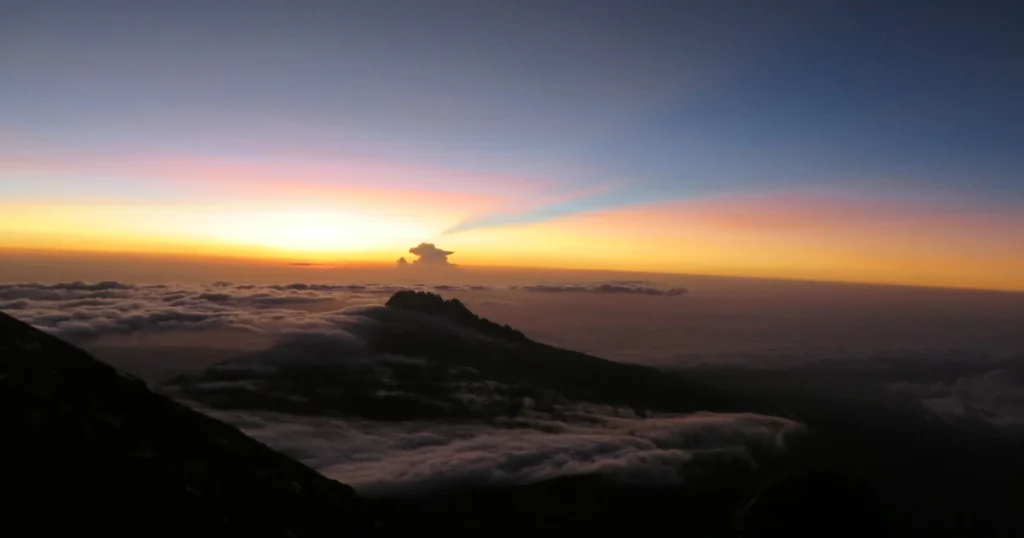
After snacks and hot drinks, we start the most demanding part of the trek. Light is provided by your head torches and the moon on a clear night. As you ascend on zigzagging trails, keeping a steady pace, you will gradually wind your way up the mountain. As you approach Stella Point, the rim of the volcano, the sun will climb spectacularly behind you, staining the horizon with vibrant reds, pinks and oranges. After a short rest at Stella Point, you will continue around the crater rim for an hour until you reach the summit of Kilimanjaro, Uhuru Peak, the highest point in Africa and the world’s highest solitary peak (5895m/19,340ft). After taking your summit photos, you will descend to Barafu Camp for lunch, pack away your kit and continue trekking for 5-6 hours down to Millennium Camp (2800m), where you will have a well-deserved rest. This could be the toughest day that you have ever experienced. You will have ascended 1295m and descended 3095m in 14-18 hours. Although exhausting, you will have just achieved something extraordinary.
Meals: Breakfast, lunch, dinner
Overnight: Campsite

Day 9 (Sunday 17 October 2027):

Millennium Camp – Mweka Gate – Moshi
This morning, you will say thank you and farewell to your team of porters in a joyful Kilimanjaro-style celebration. From camp, you will trek to Mweka Gate through the rainforest (approx. 6 hours), where you will sign out from the national park and transfer back to the hotel (approx. 1 hour) for a rest and a hot shower. Tonight, you will enjoy a farewell dinner together at your hotel and can celebrate your achievements.
Meals: Breakfast, lunch, dinner
Overnight: Hotel in Moshi

Day 10 – 11 (Monday 18 – Tuesday 19 October 2027):

Moshi – Kilimanjaro – UK
Today we will transfer to the airport for your indirect flight back home, landing on Tuesday, 19 October 2027.
Meals: Breakfast

N.B. This itinerary may change due to flight schedules, unusual weather patterns, wildlife movements, the ability of the group and so on. We will do our best to keep to the set itinerary; however, we cannot be held responsible for changes that might occur outside of our control. In all such circumstances, your guide and tour leader will have the final say in the interest of the health and safety of the group
Costs & How to pay

Registration fee: £350
and then either…

Self-funded: £3,925

or

Sponsorship: £7,850

or

Flexi: £3,925 trip costs and £3,925 sponsorship for a charity of your choice

SELF-FUNDED

This option is for those who choose to pay the trip costs (flights, accommodation, food, guides, etc.) themselves. There is no sponsorship required, although if you wish to raise sponsorship for a charity, you are welcome to do so.

  • A registration fee is payable at the time of booking.
  • Trip cost balance is payable to Different Travel 10 weeks prior to departure.
  • You are welcome to fundraise separately for any charity of your choice but this is not mandatory. Any fundraising undertaken cannot be used for your trip costs.

SPONSORSHIP

This option is for those who wish to raise sponsorship to cover both the costs of the trip (flights, accommodation, food, guides etc.) and a donation to their chosen charity. There is a minimum sponsorship amount for each tour that you are required to raise in order to participate.

  • A registration fee is payable at the time of booking.
  • The minimum sponsorship must be paid to the charity 12 weeks before departure.
  • The amount the charity receives is at least 50% of the minimum sponsorship total.

FLEXI

This option is for those who choose to pay the trip costs (flights, accommodation, food, guides, etc.) themselves while still raising some funds for the charity.

  • A registration fee is payable at the time of booking.
  • Trip cost balance is payable to Different Travel 10 weeks before departure.
  • Your fundraising is payable directly to the charity. Any fundraising undertaken cannot be used for your trip costs.

*If your chosen charity is not on this list, please seek permission to fundraise for them by taking part in this challenge before making your booking.

What's included

  • Return flights
  • Airport taxes and charges
  • Local transfers and transport
  • 3* hotel in Moshi (2 nights) and tents on trek (6 nights)
  • All meals as specified on itinerary
  • English-speaking local guides
  • Porters, cooks and support crew
  • Current National Park entrance fees
  • Trekking permits
  • Access to travel app
  • Different Travel UK tour manager

What's not included

  • Any necessary vaccinations or medication
  • Tanzanian visa (current cost US$50)
  • Drinks, laundry, souvenirs and personal expenses
  • Tips and gratuities (approx US$350pp depending on group size)
  • Transport to/from UK airports
  • Personal trek kit
  • Travel insurance (must include helicopter evacuation cover)
  • Any increases in Kilimanjaro National Park fees between time of writing (May 2026) and time of departure

Have a question?

If you’ve a question about this challenge that you can’t find the answer to within the given information then complete this quick form and we’ll get back to you as soon as possible.